
 PirateQ
Contact a Pensacola State College Advisor, this program's Department Head, or Program Contact for assistance in planning your program of study.
ACCREDITED BY:

The radiography program is accredited by the
Joint Review Committee on Education in Radiologic Technology
20 North Wacker Drive, Suite 2850
Chicago, IL 60606-3182
(312) 704-5300
Email: mail@jrcert.org
The program’s current accreditation award is probation. General program accreditation information and the current accreditation award letter can be found here:
https://www.jrcert.org/programs/pensacola-state-college-warrington-campus/
RELATED DOCUMENTS
RELATED LINKS
- Health Sciences Learning Center
- American Society of Radiologic Technologists (ASRT)
- FL State Bureau of Radiation Control
- Joint Review Committee on Education in Radiologic Technology (JRCERT)
- The American Registry of Radiologic Technologists (ARRT)
SEARCH PROGRAMS
INTRODUCTION
The Associate in Science Degree in Radiography is designed to assist the student in developing and mastering basic clinical competencies and theoretical concepts of current radiography practice. The program is accredited for the length of 8-years by the Joint Review Committee on Education in Radiologic Technology (JRCERT) with the next accreditation review in Summer 2031.
The graduate of the program is eligible to apply to take the American Registry of Radiologic Technologists exam (ARRT).
Joint Review Committee on Education in Radiologic Technology
20 North Wacker Drive, Suite 2850
Chicago, IL 60606-3182
(312) 704-5300
www.jrcert.org
Special Admissions Requirements
This is a limited-access program. Admission and course registration are restricted to a specified number of students due to accreditation requirements related to student-to-faculty ratios and the availability of clinical learning experiences. Pensacola State College admits up to 25 students each fall semester.
Admission is granted on a first-qualified, first-served basis from among applicants who meet all minimum eligibility requirements. Minimum requirements for eligibility include submission of Pensacola State College application, High School Diploma or GED, a minimum grade of “C” or better in prerequisite courses and maintain a minimum prerequisite GPA of 2.75.
The prerequisite requirements for students applying to the Fall 2027 admission cycle have changed.
- BSC 2085 – Human Anatomy and Physiology I
- BSC 2085L – Human Anatomy and Physiology I Laboratory
- BSC 2086 – Human Anatomy and Physiology II
- BSC 2086L – Human Anatomy and Physiology II Laboratory
- ENC 1101 – English Composition I
- MAC 1105 – College Algebra
The following courses will no longer be accepted to satisfy prerequisite requirements:
- BSC 1080 – Essentials of Anatomy and Physiology
- BSC 1080L – Essentials of Anatomy and Physiology Laboratory
- CHM 1020 – Introduction to College Chemistry
Students are encouraged to consult with an academic advisor to ensure completion of all prerequisite requirements prior to applying to the program.
Requirements for the Associate in Science Degree for Hospital-Based Radiographer graduates:
Pensacola State College provides a means for graduates of JRCERT accredited Hospital-based two-year programs who are currently registered Radiologic Technologist to pursue an Associate Degree. To qualify, applicants must submit an application to the College. Applicants must also submit an official transcript to the College and hold a current, unrestricted RT registration. Once applicants have completed the required general education courses, they would receive 62 credits and would be awarded the Associate in Science degree.
IS THIS FOR YOU
If you have scientific abilities, like to solve problems, like working with people, and have the ability to work with equipment, this career may suit you. People in this career may be described as analytical, curious, tactful, and sympathetic.
BEYOND GRADUATION
With experience and additional training, staff technologists may become specialists, performing CT scanning, ultrasound, angiography, and magnetic resonance imaging. Experienced technologists may also be promoted to supervisors, chief radiologic technologist, and, ultimately, department administrator or director. With additional education, available at major cancer centers, radiation therapy technologists can specialize as medical radiation dosimetrists. Radiographers and radiation therapists are required to fulfill 24 hours of continuing education every other year and provide documentation to prove that they are complying with these requirements.
RELATED CAREER OPPORTUNITIES
Primary Employers
Graduates from the Radiography program work in hospitals, and physicians’ and radiological centers. Three out of five radiographers work in hospitals.
Occupations
Radiographers
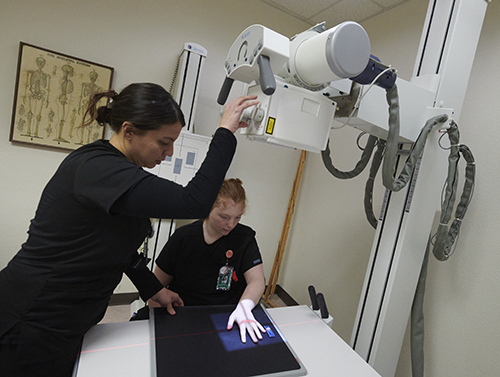
Produce X-ray images of parts of the human body for use in diagnosing medical problems. They prepare and place the patient in the correct position between the radiation source and the image receptor, protecting body areas not to be exposed to radiation. After making the exposure, they evaluate the image. Experienced radiographers may perform more complex imaging tests such as fluoroscopy, magnetic resonance imaging (MRI), computed tomography scans (CT) and special procedures.